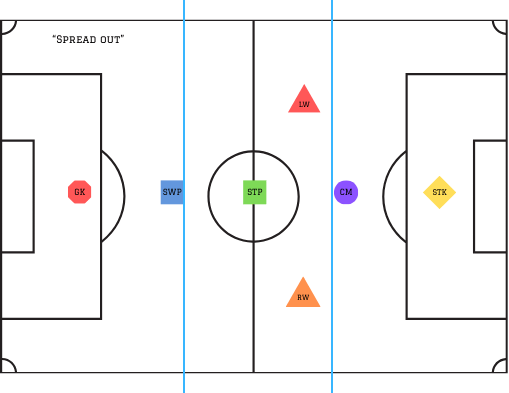
Seven players. Two defensive layers. Left and right are from the players’ view toward the opposing goal.
CM · Center Mid
Be our option quarterback.
Start here
Between the Stopper and Striker, able to connect the left and right wings.
Your area
The purple zone reaches through much of the field. You connect the back of the team to its attack.
When we have the ball
Scan before receiving and control the tempo. Slow down to draw pressure when useful; move the ball quickly when the lane opens. Count the jerseys and find who they left open. Sideways or back is a good choice when it keeps possession.
When they have the ball
Recover into a useful central position. Help close the route through the middle without taking away the Stopper’s cover.
Help these teammates
Connect STP, LW, RW, and STK. After passing, move into another angle so you can receive again.
Talk
“Man on!” and “You’ve got time!” Help the next receiver make the decision early.
Watch out for
Dribbling into five opponents because the goal is straight ahead.
How Coach Tom wants us to play
Possession and ball control win games.
Keep the ball long enough to see the next option. Passing in any direction is usually better than giving it away because you forced it.
01
Control the ball.
Make the first touch useful. Get your head up so the next decision belongs to you.
02
Keep possession.
Forward, sideways, backward: choose the pass that keeps us playing. Do not force it into a crowd.
03
Both feet down.
On a throw-in, keep both feet on the ground when you release the ball. A good restart keeps our possession.
Read the game
Count the jerseys.
Step through one example. Drawing pressure is useful only while you still have a way out.
1 / 3
The crowd tells you where the space is.
CM has drawn five opponents. Look beyond them: LW is wide with a clear lane. Do not keep dribbling just because you can.
“Get your head up. Count the jerseys.”
An example of a decision, not a fixed play. Circles with × are opponents; the small white dot is the ball. Do not wait for five opponents before passing.
This season’s reading cue
“Count the jerseys.”
When you draw several opponents toward you, they have left space and teammates somewhere else. In 7v7, five opponents around the ball means the other team has very few players covering the rest of the field.
1 · Notice
How many opponents came toward the ball? Where did they come from?
2 · Find
Get your head up. Look for the teammate or passing lane they left open.
3 · Release
Pass before they close the exit. A safe pass back can be the first step to the open side.
4 · Help again
Move after passing. The next receiver needs options too.
You do not have to wait for five players or count aloud. Recognize the crowd, then use the space. An open teammate still needs a reachable passing lane.
Invite pressure. Do not get trapped.
Carry or receive with a way out. When an opponent steps, use the space they leave. Baiting pressure only helps if you can still release the ball.
Triangles and diamonds
Give the ball carrier options at different angles. If a defender blocks one side, another teammate should be available elsewhere.
Switch fields
If everyone is on our side, move the ball to the other side. It can go directly or through CM, STP, SWP, or GK. The far-side wing stays available.
Pass, then move
Use checks, overlaps, diagonal runs, and back-and-forth passes. Your movement can create space even when the next ball does not come to you.
Defend the middle. Force outside.
The nearest player slows the ball under control. Teammates cover the space behind and inside instead of all diving at the same opponent.
Restart ready
Know your starting position before the ball comes back in. Play quickly when the option is there, legally and under control—not blindly.
The ball carrier is the quarterback
Read first. Choose. Make the defense move.
CM is our option quarterback, but every receiver becomes the next decision-maker. Teammates give that player routes and safe outlets.
Look before it arrives
Check your shoulders. Where is pressure? Where is the next teammate?
Control the first touch
Put the ball where your next action is possible. Listen to your teammates.
Choose the tempo
Sometimes slow down and draw a player. When the lane opens, move the ball quickly.
Become useful again
Pass, then change your angle. Make opponents chase the ball, not one tired dribbler.
Learn this movement first
Pass-and-go.
Two teammates can make one defender choose.
1 / 3
Pass to a teammate.
Start with a clear lane. Pass to feet when they need to control it, or into a safe path when they are already running.
A and B are teammates. × is the defender. Solid line: player run. Dashed line: pass.
Our movement vocabulary
Run with a reason.
These are movements to recognize and practice. The ball carrier still reads the defender; a route never requires a forced pass.
Check / hook
Move away to make room, then come back toward the ball at an angle.
Read: Show a clear target for a pass to feet.
Slant
Run diagonally into an open lane instead of hiding behind a defender.
Read: Time it so the passer can see you.
Post run
Angle toward the near or far goalpost as the ball moves into attack.
Read: Arrive when the pass can come; stay onside when the rule applies.
Overlap
Run beyond a teammate on the outside while they control the ball.
Read: Call early. The run may free their inside option.
Checkdown
Offer a safe supporting pass behind or beside the ball carrier.
Read: Keeping the ball gives us another attack.
Back door / back post
Arrive on the far side while defenders watch the ball.
Read: Watch both the ball and the defender; time your run.
Switch / reversal
Connect to the open side when pressure crowds this side.
Read: It can take two passes. Keep the far-side player available.
Draw and release
Invite an opponent toward the ball, then pass into the space they leave.
Read: Keep an exit. Do not dribble until every lane closes.
Football words help us remember soccer ideas. Runs create options; players cannot block or screen an opponent as they would in football.
Build from the back
“Never center the ball in front of your own goal.”
A safe backward pass and a blind square ball across our goal are different decisions. Give the keeper and defenders wide, angled outlets.
Before the restart: GK chooses a teammate with room. SWP and the next receiver make their supporting angles.
Before the first touch: the next passing option is already ready. Expect pressure as soon as the rules allow it.
On the ball: control, look up, then continue wide, connect forward, or use safe support. Do not force a pass through our goalmouth.
Off the ball: keep a second outlet available. CM connects the next pass; the far wing offers space; STK stays high as a target.
Coach Tom’s earlier build-out teaching uses a first-touch pressure trigger. Follow the referee’s current division instructions for whether a build-out line applies and when opponents can advance.
Open distance between GK, SWP, STP, CM, and STK instead of lining up beside the ball.
Wings offer width on opposite sides. The player on the far side stays ready for a switch.
Keep useful passing angles as the ball moves. A safe pass behind is still an option.
Remember: Spread out to help the pass—not so far that nobody can reach you.
Teaching notes interpret the shown positions and movement options. Coach Tom makes the live call.
Coach Tom’s original Canva playbook ↗ · Field and build-out-line rules follow the current division. In attacking-half drawings, GK is outside the pictured area.
Communication is a player’s job
Help your teammate see it.
These calls are not just for Coach Tom. Talk early, clearly, and with useful information.
“Spread out”
We have too many teammates around the ball.
Do: Open a passing angle and leave room for the ball carrier.
Teammates: Use it when teammates bunch up, then help by moving yourself.
“Get your head up”
The player is looking only at the ball.
Do: Take a quick look for pressure, space, and a teammate.
Teammates: Help the next receiver scan before their first touch.
“Look for space”
There is open grass away from the crowd.
Do: Move where a teammate can pass to you—or carry into space if you have the ball.
Teammates: Do not only call for the ball. Move into a usable lane.
“Find a teammate”
The ball carrier is trying to do it alone.
Do: Look for the available pass, including sideways or backward.
Teammates: Make yourself available as you call.
“Man on”
An opponent is arriving close to the receiver.
Do: Protect the ball or use a quick safe pass.
Teammates: Say it early, before pressure arrives. Do not shout it when nobody is close.
“You’ve got time”
The receiver has room to settle the ball.
Do: Control it, get your head up, and choose the next action.
Teammates: Check the space around your teammate before you say it.
“Switch fields”
Opponents have crowded one side; the other side has space.
Do: Move the ball to the opposite side. Use a connecting teammate if the direct pass is blocked.
Teammates: The far-side player stays available instead of joining the crowd.
“Count the jerseys”
Several opponents have been drawn toward one player.
Do: Recognize that teammates have been left elsewhere. Find a safe way out to them.
Teammates: It is a scanning cue—not a request to stand still and count aloud.
One pass, two teammates talking
Before the pass: the receiver looks around and moves into a lane.
As it travels: a teammate calls “Man on!” or “You’ve got time!” based on what they can actually see.
After the pass: the passer moves and gives another option. The conversation continues.
Useful information beats a chorus of “Pass!” Do not shout false pressure or ten different directions at one player.
Parents learn the game too
Understand what they are trying to do.
You do not have to know every soccer term. Learn the team’s language, help at home, and let players solve the game.
Possession means we have the ball.
Ball control is being able to receive, dribble, and pass on purpose. Keeping possession gives us another choice; forcing a crowded pass gives the other team the choice.
Ask: “What other pass could you see?”
Space is useful when we can reach it.
A passing lane is the path between the ball and a teammate. “Open” is not enough if a defender blocks that path. Players move to make the lane.
Ask: “Where could you move to help?”
Left and right belong to the players.
Face the opponent’s goal to find our left and right wings. Your view from the sideline might be reversed. SWP covers deeper; STP plays ahead; CM connects; STK stretches the attack.
Ask: “Who is beside you, ahead, and behind?”
A switch moves the ball to the other side.
When several opponents chase one player, someone else has space. A sideways or backward connection may be how we reach them.
Ask: “Where did their jerseys leave a gap?”
Near post and back post
Near post is the goalpost closer to the ball. Back post is the farther one. A run can create a target—or pull a defender away for a teammate.
Ask: “Did your run help even without a touch?”
Support is not crowding.
Players make triangles and diamonds so the ball carrier has choices at different angles. Standing right beside them can bring another defender into the problem.
Ask: “Did you give a new option?”
Coach Tom’s reminder
Keep both feet on the ground.
Face the field where the ball went out.
At release, some part of each foot touches the sideline or the ground behind it. Do not lift a whole foot.
Use both hands and deliver the ball from behind and over your head.
Find a teammate, then step into play to support the next pass.
A heel can rise if part of that foot stays legally grounded. The simple player cue is still: both feet down.
Under the general rule, a player is in an offside position if a scoring body part is in the opponents’ half and closer to their goal line than both the ball and the second-last opponent. Level is onside. Hands and arms do not count.
Being there is not automatically an offense: the player must become involved, such as playing the ball or interfering with an opponent. Start the run onside; do not judge only where the player receives the pass.
There is no offside offense when receiving directly from a throw-in, goal kick, or corner kick.
The whole ball crosses a sideline. The team that did not touch it last gets the throw.
Goal kick
The whole ball crosses a goal line without a goal, last touched by an attacker. A defender can take it from the goal area. It is live once kicked and clearly moving; opponents stay outside the penalty area until then.
The whole ball crosses a goal line without a goal, last touched by a defender. The attackers restart from the nearest corner area. The ball is live when kicked and clearly moving.
The ball carrier is the quarterback reading pressure. Teammates run routes, offer a checkdown, and attack the space defenders leave. In soccer, everyone keeps moving and the next receiver becomes the decision-maker.
Watch for: a player looking before receiving, a teammate making a new angle, a calm pass out of pressure, and a run that helps someone else.
On the sideline: encourage, don’t overload.
Cheer effort, teamwork, and good ideas. “Great pass,” “Good recovery,” and “Keep playing” leave room for players to think. Let coaches give tactical directions and players communicate with one another.
At home, use the same vocabulary as the guide. Ask what they saw before telling them what they should have done.
Team practice · Monday + Wednesday
More soccer. Less standing.
Practice starts when you arrive. In the coach-designated safe space, gather teammates and start a small-sided game.
21v1
32v1
42v2
53v2
63v3
MoreAnother field
No shooting lines
Standing while one player shoots is not enough soccer. Small games give everyone touches, movement, and decisions.
Triangles and diamonds
Find the passing angle. Pass and move to make the next one. Use the role names while you play.
Play fast and fit
Use short efforts, recovery, changes of direction, and repeated movement. Keep the ball work sharp; quality comes before exhaustion.
Coach Tom’s training game
4-Down Soccer
3v3 or 4v4 with two flags per player and four downs to score. It trains passing on the run, spacing, fast decisions, and the change from attack to defense.
7
Touchdown
Receive a pass in the opponent’s goal area, then score.
3
Field goal
Receive in the center circle, shoot from that circle, and score.
Launch shape
Offense sets in or near its own penalty area. Defense starts behind the blue line. The first pass or a dribble out of the launch area starts live play.
Two flags, one possession
After the first flag is pulled, keep playing. Losing the final flag while carrying the ball ends the down. Reset flags between downs.
What ends a down?
Out of bounds, a poke-away after control, or a loose ball after possession ends the down. A clean interception of a pass in flight stays live and can be returned.
Two defenders may swarm
Three or more swarming, or another defensive error, means repeat the down. An offensive error costs a down.
Play the game safely: no pushing, grabbing, or pulling a flag from someone without the ball. These are 4-Down practice-game rules, separate from match rules.
Coaching focus: launch with options, make the first pass count, run after passing, and react immediately when possession changes.
Our weekly practice rhythm
Monday · Build the shape
Control → connect → move
Player-led small game, controlled touches, triangles and diamonds, pass-and-move routes, then a game using the team shape.
Wednesday · Defend, restart, repeat
Cover → talk → restart
Small game, force-outside defending, throw-ins and goal kicks, then match play with repeated efforts and early communication.
Practice the decisions from this guide
Count the jerseys: pause a crowded moment and find the free teammate.
Switch fields: keep the far-side wing available, then move the ball across.
Team talk: give honest “Man on” and “You’ve got time” information.
Restart shape: walk to the positions on one diagram, then play from them.
Monday through Friday
Short sessions. Useful touches.
Use a safe space, a ball, and a partner or suitable wall. Lighter days leave energy for team practice.
Monday5 minutes · light before practice
Wake up the feet
Toe taps, inside touches, then outside touches.
Finish with ten controlled weak-foot passes.
Parent prompt: Can you keep the ball close without staring at it?
Tuesday10 minutes
First touch + weak foot
Make 100 controlled touches and 30 weak-foot passes to a safe wall or partner.
Add five short acceleration runs with recovery between them.
Parent prompt: Does your first touch prepare the next pass?
Wednesday5 minutes · light before practice
See the field
Look over each shoulder before receiving.
Receive side-on and alternate passes between two targets.
Parent prompt: Which target was open before the ball arrived?
Thursday10 minutes
Turn away from pressure
Practice inside and outside turns, then wall passes.
Finish with five short ball-to-sprint repetitions, recovering between efforts.
Parent prompt: Can you turn toward space instead of into a defender?
Friday8 minutes · keep it light
Game-speed confidence
Quick feet and two-touch wall work.
Finish with target passes or a few controlled finishes. Stop while sharp.
Parent prompt: Can you be quick and controlled at the same time?
Ready to play
Know your job before kickoff.
The current team update is the source for arrival time and field. Bring your gear and a teammate-first attitude.
Before leaving
Uniform, ball, water, and shin guards under socks. Remove jewelry before arrival; ask Coach Tom and the referee about any accessory that needs to stay on.
At the field
Join the team warm-up and get controlled touches. Confirm your position and whether we are playing 7v7 or adding an eighth player.
Before the whistle
Picture your starting place. Know who supports you, who you support, and the first restart shape.
During play
Get your head up. Count the jerseys. Find a teammate. Move after the pass and keep talking.
After the game
Thank opponents and officials, collect gear, and hydrate. Parents can ask what the player enjoyed or noticed without replaying every mistake.
6U · Players + parents
Four players. One diamond.
4v4, no goalkeeper. A Shark behind, two Barracudas beside, and a Dolphin ahead.
4v4 · No goalkeeperAttack ↑
School up near our goal. Spread out as we move forward.
🦈
Shark · 1 defender
Hold the back point. Chase danger away from our goal and clear it hard and wide.
🐟
Barracudas · 2 midfielders
Take the two side points. Gather the ball, push wide and upfield, help on offense and defense, and shoot when the chance comes.
🐬
Dolphin · 1 striker
Stay high in the attacking half. Hunt goals, follow shots, and be ready for the rebound.
Two calls to remember
“School up!” Come together when danger is near our goal. The Shark protects behind the others.
“Spread out!” Open the diamond as we move forward. The two Barracudas give us width. Get across halfway, attack the goal, and follow rebounds.
Games we play
Sharks vs. Minnows · Monkey in the Middle · Frog Game · stop/go · little goals · simple 1v1.
They teach controlled touches, starting and stopping, space, courage, and the joy of playing.
Practice rhythm
Play immediately, learn one simple skill, enjoy a themed game, play small-sided soccer, and finish with the team cheer.
Five minutes at home
Dribble around three safe objects, stop the ball five times, then race it to a little goal.
Parent job
Bring water and shin guards, remove jewelry, cheer effort, and let the players solve the game. Check the team update for time and field.